
Pomiferous
Welcome to the world's most extensive apples (pommes) database.
Information on over 7,000 apples is available here, all carefully researched and provided in a way that is easy to navigate.
Peasgood’s Nonsuch
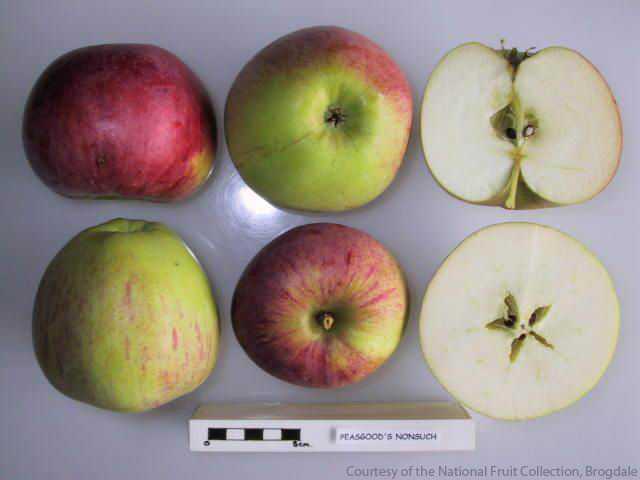
type: Cooking, Culinary, Dessert
synonyms: Peasgood Nonesuch, Peasgoods Goldrenette
identification: Large tending to very large, round and slightly flattened at the ends, sometimes round-conic. The base colour is green with red flush covering up to three-quarters of the surface, over which is a dense pattern of short, brighter red broken stripes. Light-coloured lenticels. The calyx is small and open, set in a shallow basin. The stem is short and medium thick, set in a deep and narrow cavity.
characteristics: The flesh is cream coloured, coarse-grained, tender. Juicy, sweet and slightly tart.
uses: Dessert and cooking. Makes a lovely baked apple.
origins: Grown from an open-pollinated seedling of Catshead planted in 1853 by either Mrs. or Mr. Peasgood in Stamford, Lincolnshire (U.K.). England's eminent pomologist and author, Robert Hogg, states in the 1884 edition of "The Fruit Manual" that "This handsome apple was presented before the Fruit Committee of the Royal Horticultural Society on September 18th, 1872, and received a first-class certificate. It was raised by Mr. Peasgood, of Stamford, and is one of the most handsome autumn apples in cultivation." The more colourful version has it that it was one of five seeds planted by Emma Manby at Grantham, Lincolnshire, in 1860 when she was 16 years old. Only one of the seeds survived and she took it with her to Stamford when she married and became Mrs. Peasgood.
cultivation: Moderately vigorous, spreading tree. Bears fruit on spurs. Produces good crops ready for harvest in the middle o the first period. Resistant to scab and mildew. Needs well? drained soil and warm climate.
progeny: Houblon , Monarch , Renown , Rival , Paroquet , Charles Ross , @5486,, Prince George , Colonel Yate
mutations: The Crimson Peasgood is a bright red mutation of the Peasgood Nonsuch.
cold storage: Keeps for two months in storage.
vulnerabilities: Resistant to scab, susceptible to canker.
harvest: In the middle of the fourth period.
notes: A few sources of information list the Alexander -- including Wikipedia -- as flower parent of this variety. However, most pomologists of the 1800s, including Britain's eminent Robert Hogg, state that the flower parent was Catshead .
pollination group: D
pollination peak: 14
ploidism: Partially self fertile. The blossoms are easily damaged by late frosts.
cold storage weeks: 8
harvest period: 4
Donate a cider?
©2016-2021 Pomiferous.com. All rights reserved