
Pomiferous
Welcome to the world's most extensive apples (pommes) database.
Information on over 7,000 apples is available here, all carefully researched and provided in a way that is easy to navigate.
Hawthornden
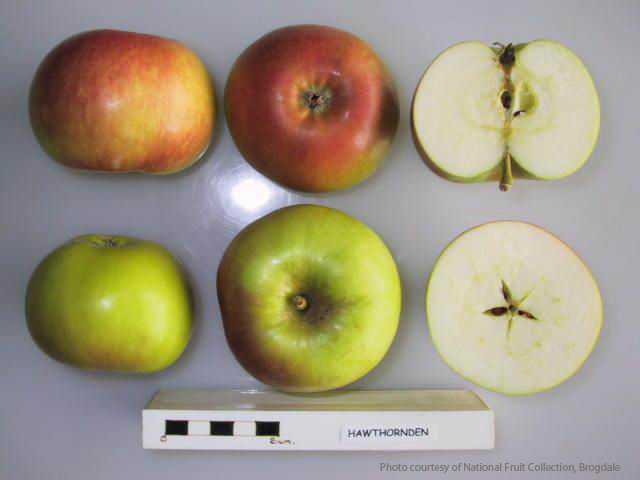
type: Culinary, Sauce
synonyms: Haley, Hawley (there is also an American-bred apple by this name, please see Hawley ), Hawthorden, Hawthornden, Hawthornden Red, Hawthornden White, Lincolnshire Pippin (note that there is also an apple by the name Lincolnshire Holland Pippin ), Lord Kingston, Old Hawthornden, Red Hawthornden, Shoreditch White (there is also a cultivar by this name, please see Shoreditch White ), Wheeler’s Kernel, White, White Apple. Reported to be referred to as Maiden’s Blush though this is not the same cultivar.
summary: A heritage Scottish cooking apple that makes a flavourful, brisk and creamy sauce.
identification: Medium tending to large. Round, sometimes flattened and often with a prominent rib on one side. Skin base colour is yellow, flushed with orange-red on the sun-exposed face. Often there is a light bloom on the surface. The calyx is small, slightly open and set in a shallow, ribbed basin. The stem is short, stout and set in a deep, russetted cavity. Thin skinned.
characteristics: The flesh is creamy-white, firm, crisp and very juicy. Often quite tart.
origins: While the parentage of this apple seems to have faded away in the course of more than two centuries or more, we do know for certain that it originated in Scotland and that it was named for the town where it originated — Hawthornden, located 12 kilometres southeast of Edinburgh (Scotland) — made famous as the birthplace of poet William Drummond in the 1600s. The apple likely originated or arrived sometime in the 1700s and was, according to Britain's illustrious pomologist Robert Hogg, not mentioned in print until it arrived on British soil. "The first mention of it is in the catalogue of Leslie and Anderson, of Edinburgh, but I do not think it was known about London till 1790, when it was introduced to the Brompton Park nursery." he stated in in his "The Apple and its Varieties" published in 1859. It became a popular Victorian garden variety and was commercially grown in Kent and by London market gardeners during the 1800s. Unfortunately, its popularity waned by the 1890s, largely because the fruit bruises easily in transport.
cultivation: Moderately vigorous, upright spreading spur-bearer. Biennial.
cold storage: Keeps up to one month in storage.
vulnerabilities: Prone to mildew. Somewhat sensitive to scab.
harvest: Ready for harvest late in the fourth period.
pollination group: D
pollination peak: 13
ploidism: Diploid. Self sterile.
cold storage weeks: 4
harvest period: 4
hardiness: 4
Donate a cider?
©2016-2021 Pomiferous.com. All rights reserved