
Pomiferous
Welcome to the world's most extensive apples (pommes) database.
Information on over 7,000 apples is available here, all carefully researched and provided in a way that is easy to navigate.
Obelisk
type: Dessert
synonyms: Ballerina Obelisk, Crimson Spire. Marketed under the Flamenco trademark.
summary: One of several columnar apple trees developed at the East Malling Research Station during the late 1900s, this is a late-blooming, late harvest dessert apple and tends to be slightly more vigorous than others in the series.
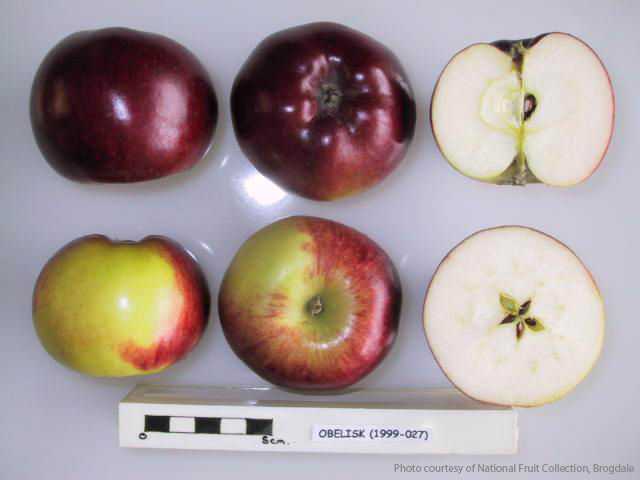
identification: Small to medium size, round and flattened and weakly ribbed. The base colour is yellow over which the apple is washed solid maroon red on the sun-exposed faces; faint red stripes on the shaded faces. The calyx is medium size and closed, set in a medium deep and medium wide basin which is surrounded by a knobbed crown. The stem is short, medium thick and extends as high as the narrow, moderately deep cavity. The medium thick skin develops some greasiness as the fruit matures.
characteristics: The flesh is white, fine-grained and crisp. Juicy and brisk when first harvested, becoming sweet and mellow after six weeks in storage.
origins: One of a series of six columnar apple trees developed by Kenneth Tobutt at The Kent Incorporated Society for Promoting Experiments in Horticulture's East Malling Research Station in Maidstone, Kent (U.K).during the 1970s. The Obelisk was created by by crossing A1583 (a cross of Cox’s Orange Pippin x Court Pendu Plat ) with pollen from Wijcik Spur McIntosh . It was designated SA54/81, evaluated and introduced at the 1988 National Fruit Trials at Brogdale Farm in Faversham, Kent. Released in 1991.
cultivation: Moderately vigorous, upright and very compact, columnar spur bearer. The fruiting spurs develop close to the main stem. Produces annual fruit the first few years, then becomes prone to biennial harvests. Some side branches do develop are are generally trimmed off to maintain the columnar profile. In windy locations, the trees do require some shelter to avoid damage to the fruit spurs which can result in secondary branching. Performs best on MM106 rootstock.
cold storage: Keeps up to four months in cold storage.
harvest: Ready for harvest in the first half of the fifth period.
pollination group: D
pollination peak: 12
ploidism: Diploid. Self sterile.
cold storage weeks: 16
harvest period: 5
hardiness: 4
Donate a cider?
©2016-2021 Pomiferous.com. All rights reserved