
Pomiferous
Welcome to the world's most extensive apples (pommes) database.
Information on over 7,000 apples is available here, all carefully researched and provided in a way that is easy to navigate.
Newtown Spitzenburg
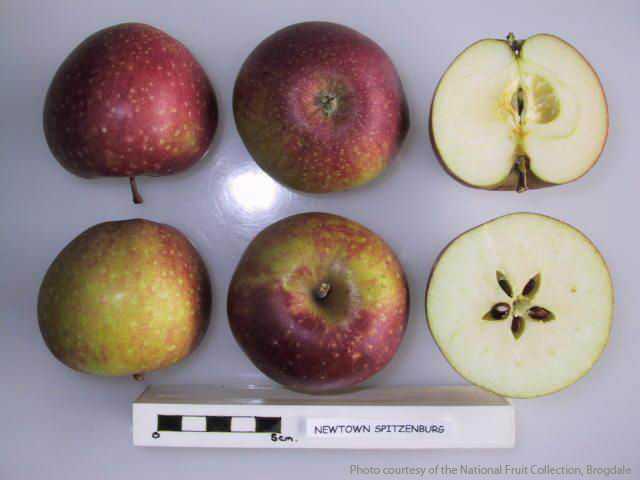
type: Culinary, Cider, Dessert, Jelly, Sauce
synonyms: Barrett’s Spitzenburg, Joe Berry, Joe Berry, Burlington, Burlington Spitzenburg, Esopus Opus, English Spitzenburg, Esopus Vandervere, Honey Grindstone, Kounty, Kountz, Matchless, New York Vandevere, New York Spitzenburg, Newton, Ox Eye (also a synonym for Vandevere and for Gloria Mundi ), Queen of the Dessert, Spiced Ox Eye (also a synonym for Vandevere ), Vandevere and Vandervere (both synonyms for Vandevere ), Vandevere/Vandervere of New York. It, as well as other Spitzenburg varieties, are referred to by several variations of the spelling including Spitzemberg, Spitzenberg, Spitzenburgh, Spitzenburg is considered the correct spelling. Sometimes the name is shortened to "Spitz" and "Spitzenburg," but these could also refer to the Esopus Spitzenburg or Ribston Spitzenburg or Flushing Spitzenburg . The Newtown Spitzenburg is often considered synonymous with Vandevere, but this is distinctly another variety of apple which likewise originated in the Long Island region of New York (U.S.A.).
summary: An American dessert apple, possibly of Scandinavian origin considered by some to be more flavourful than the better known Esopus Spitzenburg when grown in opiimum conditions. Also favoured for cider.
identification: Medium size tending to small, round and often somewhat conic. The skin base colour is pale yellow washed with red and marked with darker streaks on the sun-exposed face. large pale lenticels. The calyx is small and partly open, set in a s basin. The stem is short to very short and moderately heavy, set in a deep and narrow, russetted cavity. Usually covered in a thin bloom at harvest time.
characteristics: The flesh is creamy-yellowish, coarse-grained and firm. Juicy, sweet, slightly tart and nutty.
uses: Produces unreliable crops, the tree is sensitive to soil and climatic conditions, and the fruit tends to be on the small side. Often confused with the Vandevere and the Esopus Spitzenburg.
origins: Likely a seedling apple grown since the early 1800s or possibly the 1700s near in the village of Newtown (now the corner of Broadway City in Queen's County, Long Island, New York (U.S.A.). It is often described has having originated in 1817, however, that is the year it was first mentioned by William Coxe in his 1817 book "A View of the Cultivation of Fruit Trees and the Management of Orchards and Cider" under the name Newtown Spitzemberg and is pegged with the notation that "it was brought from Newtown on Long Island." James Thatcher subsequently mentioned it in his 1822 book "The American Orchardist" under the heading Spitszenburgh, noting that there are three apples so known—the Esopus, the Flushing and the Newtown. In "The Apples of New York" (published, 1905), S.A. Beach concedes that the cultivar stems from the Long Island community of Newtown in New York State adding that "It was at one time quite popular in some sections of state, particularly in the districts along the Hudson , but is now seldom planted and is gradually going out of production." Its origins may have been in the seeds brought by settlers from Europe, including Dutch and Swedish settlers who came to the area in the 1600s.
cultivation: Large, vigorous, spreading tree.
cold storage: Up to three months.
harvest: Ready for harvest late in the fifth period.
notes: The Newtown Spitzenburg is often referred to as Newton (only one "w") Spitzenburg, as in Newton Wonder but, in the case of the Newton Spitzenburg, the correct usage is Newtown (with the second "w"). The name Newtown is linked to a Dutch settlement/fur trading post by the name of New Amsterdam dating back to the first half of the 1600s. When the British took possession of the colony, in 1664, the settlement was renamed New Town, later Newtown, and existed under that name until 1897 when it was changed once again, this time to Elmhurst and, a year later, it became part of Greater New York City.
pollination group: D
pollination peak: 14
ploidism: Diploid. Self sterile.
cold storage weeks: 12
harvest period: 5
hardiness: 4
Donate a cider?
©2016-2021 Pomiferous.com. All rights reserved