
Pomiferous
Welcome to the world's most extensive apples (pommes) database.
Information on over 7,000 apples is available here, all carefully researched and provided in a way that is easy to navigate.
Vandevere
type: Cooking, Culinary, Cider, Pie, Sauce
synonyms: There are many variations on the name of this apple, including Vandevere, Vanderveer, Vandervere and Vandiver and, to further complicate matters, these are also listed as synonyms for Newtown Spitzenburg . Aesopus Ven der Vere also crops up on occasion. The late Creighton Lee Calhoun listed Fall Vandevere, Gibbon's Smokehouse, Gray Vandevere, Green Vandevere, Vandiver, Imperial Vandevere, Lasting Vandevere, Mill Creek, Old Vandevere/Vandervere, Ox Eye (also a synonym for Newtown Spitzenburg and for Buckingham ), Pennsylvania Vandevere, Red Vandevere, Staalcubs, Stalcubs, Striped Vandevere, Vandervere, Vandevere/Vandervere Pippin, Vandevere/Vandervere of Cincinnati, Watson's Vandevere, White Vandevere, Yellow Vandevere and Little Vandevere as names for this apple. The Newton Spiizenburg is sometimes called the Vandervere/Vandevere/Vandeveer of New York. The name Newton Spitzenburg is often listed as a synonym for the Vandevere but this is confusing since it primarily refers to Newtown Spitzenburg . Sometimes referred to as Staalcubs, Stalcubs or Stalcops
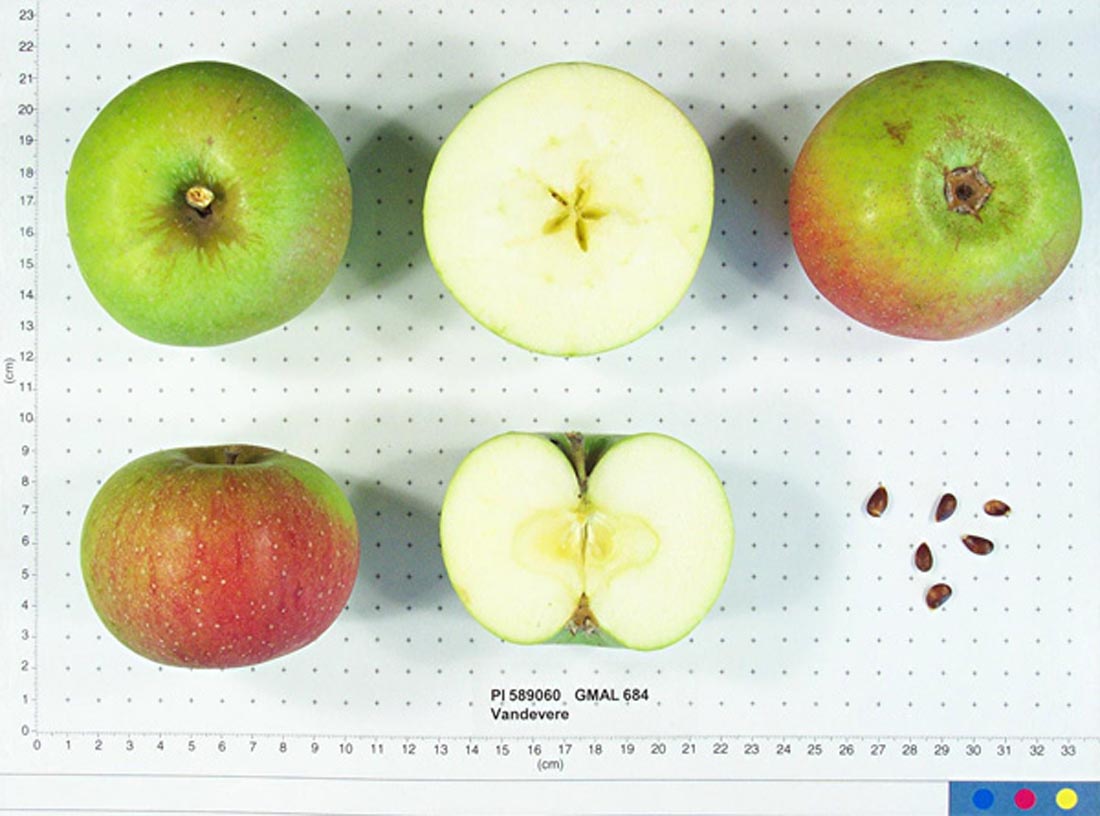
identification: Medium to large size, round and somewhat flattened. Skin is yellow with over which are scattered red stripes and often pale orange flushes. Marked with an abundance of raised, pale-russet lenticels. The stem is long and somewhat slender, set in a deep and narrow cavity. The calyx tends to be small and closed, set in a moderately deep and funnel-shaped basin.
characteristics: The flesh is yellowish, crisp to the point of being hard. Juicy, sprightly and sweet.
origins: Commonly listed as being a wilding found growing in the late 1700s on farmland that had been owned by a Dutch settler by the name of Van der Veere (likely Cornelis Janszen Dominicus/Van der Veer) since 1659. The property was located in the Flatbush area (later known as Brooklyn) of New Netherland which was, at the time, a Dutch colony that claimed much of the area between the Delaware and Hudson Rivers, including the island of Manhattan which is now the sprawling metropolis of New York City, New York (U.S.A.). It is assumed that it came from a discarded apple core tossed into an undisturbed and fertile patch of soil. Since much of the area was cleared and developed by settlers from continental Europe it is possible that the Vandervere apple has ties to varieties grown in western Europe at the time.
Mentioned as one of many assets in a land sale offer in 1768
cultivation: Moderately vigorous, medium size at maturity. Upright spreading growth. Biennial with only moderate crops.
progeny: Smokehouse
cold storage: Keeps up to four months in storage becoming waxy and soft over time, but still usable for cooking..
harvest: Ready for harvest in the fifth period.
ploidism: Self sterile.
cold storage weeks: 16
harvest period: 5
Donate a cider?
©2016-2021 Pomiferous.com. All rights reserved