
Pomiferous
Welcome to the world's most extensive apples (pommes) database.
Information on over 7,000 apples is available here, all carefully researched and provided in a way that is easy to navigate.
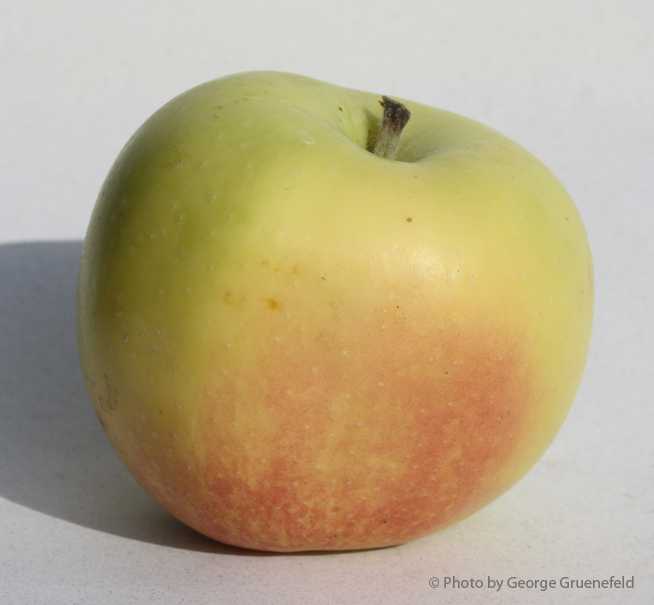
Winter Banana
type: Culinary, Cider, Dessert, Juice
synonyms: Banana, Flory, Flory Banana
identification: Medium to large size, round to round conic, often irregular in shape with one side usually higher than the other. The skin is smooth and waxy; base colour is yellow with light red blushes on the sun-exposed face. Liberally strewn with small, dark lenticels. The eye is medium size and open, set in a shallow basin which can be surrounded by a knobbed crown. The stem is club shaped, short and stout, set in a medium deep and funnel shaped cavity which can be lined with a fine russet.
characteristics: Cream coloured flesh is coarse-grained, crisp and melting. Juicy, sweet, slightly tart and very fragrant with noticeable banana aroma. In his book "Systematic Pomology," (published 1925), Ulysses P. Hedrick described it as “a suggestion of musk exclusively the property of this apple.”
uses: Intended as a dessert apple. Flavours do not hold up well in cooking or storage. For the best flavours, try eating this apple as slices rather than biting into it. Best apples are firm rather than soft. Interesting juice and additive to blended cider.
origins: Discovered as a chance seedling by David Flory on his farm in Cass County, Indiana (U.S.A.), in 1876. Commercial introduction was carried out by Greening Brothers Nursery of Monroe, Michigan, in 1890. Pomologist Ulysses Hedrick notes that it resembles an apple he received from Holland, name unknown, and suggests that it might be an Old World variety which somehow found its way to North America.
cultivation: A hardy, moderately vigorous, upright-spreading tree with a tendency to drooping second year growth. Bears fruit on spurs. Produces small harvests at a fairly young age, but heavier as the tree matures. Annual bearer. Suitable for espalier and trellis training. Grows best in regions that provide hot summers.
progeny: Criterion
mutations: Spur Winter Banana
cold storage: Does not store well and tends to bruise easily.
vulnerabilities: Highly susceptible to scab, somewhat susceptible to fire blight, rust and mildew.
harvest: Early in the fourth period.
pollination group: D
pollination peak: 12
ploidism: Diploid. Self sterile.
brix: 15.5
hardiness: 4
Donate a cider?
©2016-2021 Pomiferous.com. All rights reserved