
Pomiferous
Welcome to the world's most extensive apples (pommes) database.
Information on over 7,000 apples is available here, all carefully researched and provided in a way that is easy to navigate.
Golden Winter Pearmain
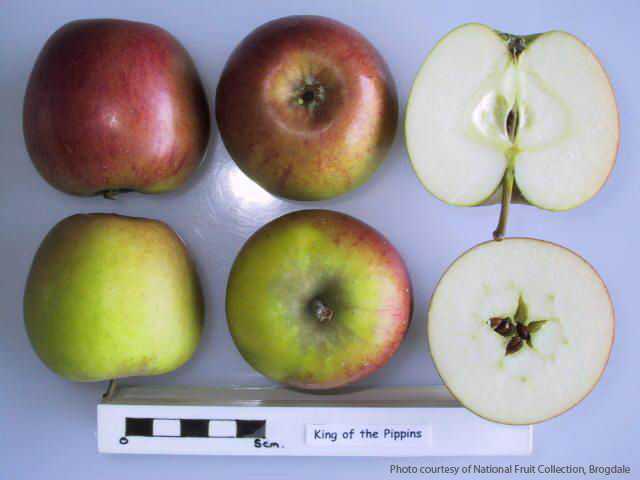
type: Culinary, Cider, Dessert, Pie
synonyms: Also known and referred to by the following synonyms: English Winter Gold Pearmain, English Winter Golden Pearmain, George I, George II, Hampshire Golden Pippin, Hampshire King of the Pippins, Hampshire Yellow, Hampshire Yellow Golden Pippin, Herzog's Reinette, Jones’ Southampton Pippin, Jones' Southampton Yellow, King Pippin, Orange Pearmain, Pike's Pearmain, Prince's Pippin, Princess Pippin, Queen of the Pippins, Reine des Reinettes, Ruckman’s Pearmain, Seek-no-Farther, Seek-no-Further, Shropshire Pippin, Ventmuss Ellicott Pippin, Winter Gold Pearmain.
The Queen of the Pippins, King of the Pippins, Kroon Reinette and Reine des Reinettes are frequently considered to be similar though seperate cultivars; others maintain that they are simply regional names for the Golden Winter Pearmain which is their ancestral name.
summary: An excellent heritage baking apple when picked under-ripe but also highly flavourful and sweet when left to fully ripen. This apple is traditionally used for making tartes tatin. Also presses out to a sweet must that is excellent for making cider. Also used in cider making, adding sweetness and nuttiness to the final product.
identification: Medium tending to small, round-oblong to conic-oblong, sometimes square-oblong, very lightly ribbed. The skin is thick. smooth and shiny, sometimes lightly russetted, except around the stem cavity where the russet is heavy. Pale yellow to pale orange with patches of fine russet and small russet lenticels on the shaded face. The sun-exposed face is orange with crimson streaks and dotted with russet lenticels. The stem is medium long, medium stout and often set alongside a fleshy swelling; the cavity itself is shallow, green and russetted. The calyx is large and open or partly open, set in a wide and shallow basin, lightly plaited.
characteristics: The flesh is cream-coloured, fine-grained, firm, crisp. Juicy and sweet with virtually no acidity. Slightly spicy and distinctly nutty with the best almond flavours developing two to three weeks after harvest. Apples growing on a shaded aspect tend to be distinctly bland in flavour. Browns quickly when exposed to air.
origins: Because of its wide distribution, the history of this apple is convoluted and its proper name depends on where the tree is grown. There are stories of it having been sold at England markets in 1250, others suggest that it arose as a chance seedling around 1510 in Normandy (France). There is little question that it was grown as early as the 1600s in western portion of what is now continental Europe, but where within that far-flung region is a matter of conjecture. The Netherlands, Germany, Switzerland and France all lay claim to its origin and it was likely called Golden Pearmain during those early years. Subsequently, as it became better known, it was tagged with regional appelations and, by the late 1700s it had become known as the Kroon Renet in Holland, Gold Renette in the Germanic states and Reine des Reinettes in the Normandy region of northwestern France. Early in the 1800s, it had also crossed the English Channel to the British Isles under the name Golden Winter Pearmain and was initially promoted in the markets as English Golden Pearmain. In an attempt to further promote its sales, Kirke, a British nursery keeper based at Brompton near London, re-introduced it as Queen of the Pippins in an article published in the 1827 issue of "Pomological Magazine" although he later called it King of the Pippins in his nursery catalogues. The noted British pomologist, George Lindley was perhaps the first to describe it as a British apple using the name King of the Pippins in his "A Guide to the Orchard and Fruit Garden" (published 1831). "This very excellent apple was brought into notice by Mr. Kirke, of Brompton." Under the name King of the Pippins, the apple subsequently made its way across the Atlantic Ocean to various British colonies where it was grown extensively as a market apple. There exists some controversy as to whether the King of the Pippins of the colonies is indeed an offshoot of the Golden Winter Pearmain — possibly as a seedling thereof — or actually a similar variety that was developed on foreign shores as some apple growers/experts suggest. Considering the many subtle similarities between the two, there exists a strong argument that the King of the Pippins is a seedling of the Golden Winter Pearmain rather than an unrelated cultivar.
cultivation: On its own roots, it grows vigorously during the first few years, then matures to a moderately vigorous, pyramidal tree. Partial tip bearer. Needs annual trimming to maintain fruit size and to offset biennial bearing since it has a strong tendency to bear fruit every other year, especially when the tree is still somewhat young. Thinning is needed to promote fruit production. Grows best in warm, rich and sandy soils. Tolerates higher elevations but needs shelter from the wind. The blossoms are slightly sensitive to late frost. Frequently planted in orchards as a source of abundant, viable pollen, particularly so for Cox's Orange Pippin. Suitable for trellis/espalier training. Well suited for farm-gate and u-pick sales rather than commercial production. Does best when grafted on vigorous rootstock.
cold storage: Keeps up to three months. Becomes mealy when kept overlong.
vulnerabilities: Susceptible to scab and mildew, somewhat susceptible to canker.
harvest: Ready for harvest starting in the second half of the fourth period, but for eating out of hand they should be left on the tree for a couple weeks longer. Needs to ripen fully for the flavours to develop. Becomes mealy if left overlong.
notes: The wood of this tree is exceptionally hard and strong.
The word pippin refers to the pip (seed) of an apple and is historically used to refer to an apple tree or variety of apple grown from seed rather than from a grafted rootstock.
There has been some confusion over the Golden Winter Pearmain and the King of the Pippins. According to some references, the King of the Pippins is simply a synonym for the Golden Winter Pearmain. Others, particularly Britain's Robert Hogg insisted that the true King of the Pippins differs from the Golden Winter Pearmain in that the latter has a golden yellow base colour, no major russetting save for the lenticels and a much longer stem set in a russetted cavity. He set its harvest period almost a month and a half earlier than the King of the Pippins.
Gold Winter Pearmain, Golden Pearmain, Golden Winter Pearmain, Reine de Reinettes, Hampshire Yellow, Jones’ Southampton Pippin, Prince’s Pippin, Shropshire Pippin. Plassart, Bonin, Lepage, Belrene. Also often referred to simply as “King” resulting in some confusion since this name is also used for Summer King , Warner’s King and King David . Sometimes also referred to as Seek-No-Farther, but his name is also used as the synonym for Mountain Boomer , Westfield Seek-No-Further and Yorkshire Greening .
The history of this apple is both convoluted and complicated.
pollination group: D
pollination peak: 13
ploidism: Diploid. Partly self-fertile but produces best crops when grown in proximity to a source of viable pollen. Avoid using Golden Delicious and Granny Smith to pollinize this apple.
cold storage weeks: 12
brix: 12
harvest period: 4
hardiness: 5
Donate a cider?
©2016-2021 Pomiferous.com. All rights reserved