
Pomiferous
Welcome to the world's most extensive apples (pommes) database.
Information on over 7,000 apples is available here, all carefully researched and provided in a way that is easy to navigate.
Warner’s King
type: Culinary, Juice, Sauce
synonyms: Barker’s Seedling, D. T. Fisch, D. T. Fish, David T. Fish, Drumlanrig Castle, Fish, Fish D. T., Fish’s Rambour, Killick’s Apple, Killick’s Big Apple, King (this is also a synonym for Winter King and King of Tompkins County), Nelson’s Glory, Poor Man’s Friend, Salopian, Silverton Pippin, Veitch’s Cluster, Warner’s Seedling, Weavering.
summary: The cooking apple from Britain is another in a class of oversize varieties grown for market and farm gate sales.
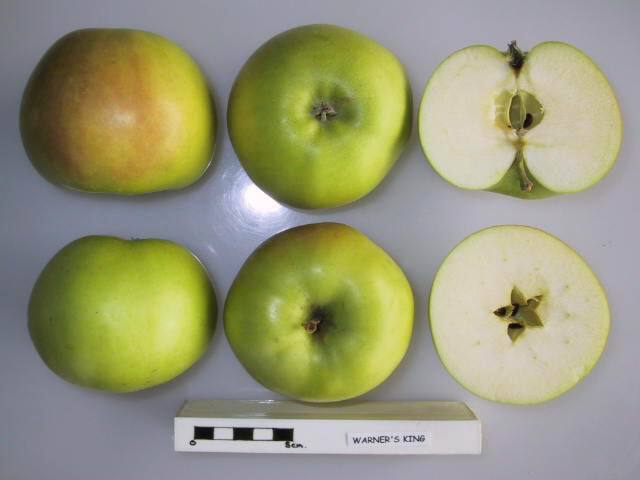
identification: Very large, round to flat rounded and sometimes angular. The skin colour is green maturing to yellow sometimes with a pale orange blush, over which are patches of pale brown russet and russeted lenticels. The calyx is medium size and closed, set in a medium deep and narrow, lightly ribbed basin. The stem is short, medium thick and set in a deep, funnel shaped cavity which can be lightly russetted. Th skinned with a greasy feel at maturity.
characteristics: The flesh is white, coarse grained, firm, crisp. Juicy and sweet, slightly tart.
uses: Makes a sharp, flavourful apple sauce. Also favoured for juice.
origins: Originated as a chance seedling found growing in Kent in southeastern Britain (U.K.) during the 1700s and subsequently raised by by a nurseryman by the name of Warner who dubbed it the King apple because of its size. It was later promoted by Thomas Rivers of Hertfordshire by the name Warner's King and by the 1800s were widely grown commercially. More modern apples better suited to commerical orchards have largely pushed Warner's King into the sidelines and it has become more of a hobby orchard variety that sells well at farm gates and markets.
cultivation: Vigorous, upright spreading tree. Bears fruit on spurs. Provides heavy crops. Blossoms are sensitive to frost.
progeny: Norfolk Beauty
cold storage: Keeps up to three months. The acidity mellows in storage.
vulnerabilities: Susceptible to scab and canker.
harvest: Late in the fourth period.
pollination group: C
pollination peak: 9
ploidism: Triploid. Self sterile. Produces no viable pollen.
cold storage weeks: 12
harvest period: 4
flowers: White
Donate a cider?
©2016-2021 Pomiferous.com. All rights reserved