
Pomiferous
Welcome to the world's most extensive apples (pommes) database.
Information on over 7,000 apples is available here, all carefully researched and provided in a way that is easy to navigate.
Tuscan
type: Dessert
synonyms: Bolero, Emerald Spire, Emeraldspire, Ballerina Emerald Spire.
summary: One of six columnar cultivars developed at the East Malling Research Station in Kent (U.K.). These include Maypole, Telamon, Tuscan, Trajan, Charlotte and Obelisk.
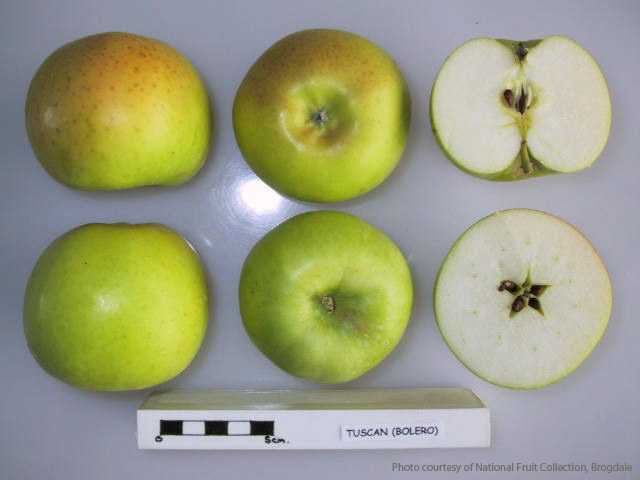
identification: Medium size. Round to round flattened in shape with some tendency to be asymmetrical. Skin is smooth with a base of green colour maturing to yellow. Faded orange blush on the sun exposed face, about a quarter of the total surface. . Some russet patches may occur. The stem is short and medium thick, set in a deep and wide cavity. The calyx is small and closed, set in a moderately deep and wide basin. Light russet patches can occur at the cavity and basin. There is some greasiness to the skin.
characteristics: Flesh is cream-coloured, moderately crisp and juicy. Sweet-sharp. Very similar to its Greensleeves parentage. Tends to brown slowly when exposed to air.
uses: Intended as a fresh-eating apple.
origins: This is another of the Ballerina/Colonnade series of columnar apple trees developed under the direction of Ken Tobutt at The Kent Incorporated Society for Promoting Experiments in Horticulture's East Malling Research Station in Maidstone, Kent (U.K.). It was created in 1976 by pollinating a Wijcik Spur McIntosh and pollen from Greensleeves . The Wijick McIntosh is a sport of the McIntosh which has a pronounced proclivity to grow fruit on spurs off the main stem. Introduced at the 1984 National Fruit Trials, Brogdale Farm, Faversham, Kent. Initially designated SA 25 24 the apple was renamed Tuscan and offered on the market as Bolero and Emeraldspire under the Ballerina and Colonnade banner.
cultivation: Moderately vigorous tree with an upright, columnar growth habit. Spur bearer. Typical of columnar trees, the fruit naturally develops on spurs close to the main stem making it ideal for small gardens and even patio pots. Some side branching off the main stem can occur, but it is generally caused as a result of damage to a fruiting spur and can be trimmed away. Foliage tends to be dense along the pole of the tree. Shelter is essential in windy locations since high wind can damage the terminal buds, causing secondary branching. Trees can be planted about one metre apart. Does well on MM106 rootstock.
vulnerabilities: Susceptible to scab, cedar apple rust, powdery mildew and fire blight.
harvest: Ready for harvest in the middle of the fourth period.
pollination group: A
pollination peak: 2
ploidism: Diploid. Self sterile.
harvest period: 4
hardiness: 4
Donate a cider?
©2016-2021 Pomiferous.com. All rights reserved