
Pomiferous
Welcome to the world's most extensive apples (pommes) database.
Information on over 7,000 apples is available here, all carefully researched and provided in a way that is easy to navigate.
RF: Niedzwetzkyana's Apple
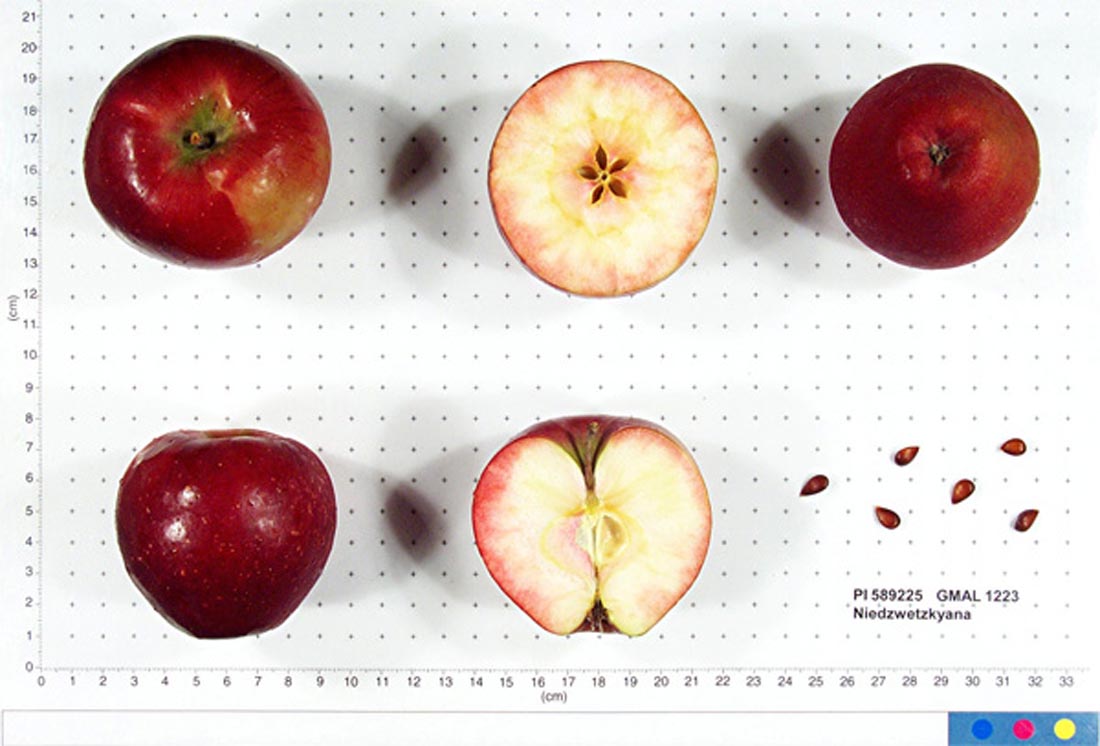
type: Culinary, Cider, Jelly, Ornamental, Pollinization, Sauce
synonyms: Named in honour of Vladislav E. Niedzwiecki, the Russian amateur naturalist from Almata, (Kazakhstan, Central Asia), for his efforts through the late 1800s to introduce the fauna and flora of Central Asia to the rest of the world.
summary: Found growing scattered across the Shin Tan Mountains of Central Asia and introduced in the Western World through the latter half of the 1800s.
identification: Small, tending to medium in size and round-conic in shape. The base colour is pale green with deep red over-colour.
characteristics: The flesh is pink, tending to full-red. Coarse-grained. Sweet and tart, both fresh and cooked.
uses: In the course of introductions of the Niedzwetzkyana, the toll on wild trees in Kazakhstan has been heavy, to the point where the native trees declined to fewer than 150 trees surviving on their native range despite efforts to sustain natural stands of this apple. Cultivated Niedzwetzkyana trees, on the other hand, are fairly abundant among apple growers worldwide.
origins: The varietal came to the attention of botanists as single trees widely scattered through the mountain regions of Kazakhstan and neighbouring countries. The small, red-fleshed apples found growing wild were treasured for their moderately sweet and cold-hardy properties. In the late 1800s, Niedzwiecki, introduced it to botanists in Western Europe and the Americas. Among his European contacts was Dr. Georg Dieck at the Zöschen National Arboretum in Merseburg (Germany) who later donated specimens of this variety to the Späth Nursery in Berlin, which, in turn, exported the trees to the U.S.A. as of 1896.
In Volume VI of the 1921 edition of "Addisonia" the Niedzwetzkyana was described by American botanist George V. Nash with all the passion that it was due: "This is a most unusual apple, striking in all its phases, all parts partaking some shade of red—the bark is very dark purple red, the flowers are a deep rose purple, and the fruit a deep crimson purple outside with a flesh of a lighter shade; even the young leaves are purplish, and mature ones turn red in the autumn. It is a small tree of rather irregular habit, usually attaining a height in cultivation of ten or fifteen feet. In flower or fruit it is an unusually beautiful sight, and is worth of a place among our most decorative apples."
cultivation: Vigorous. Spur bearer. In its native form, the Niedzwetzkyana was described by Dr. Georg Dieck, director of Germany's Zöschen Arboretum in the late 1800s, as "winter-hardy, undemanding for care, drought resistant, and interesting exclusively for ornamental horticulture and hybridization."
progeny: Etter's Rosybloom Crab, also known as Crimson Gold .
cold storage: Keeps up to one month in cold storage.
harvest: Mid-late to very late. Fruit holds firm on tree beyond ripeness.
notes: Two distinct groups of red apples originated in Central Asia. Type 1, known as Niedzwetzkyana’s Apple came to the attention of western fruit growers in the late 1800s. Its characteristic is that the flesh, skin, flowers, leaves and wood all show red. In addition to being an eating apple, it is also an ornamental apple.
Type 2 on the other hand, is referred to as the Surprise Group (please see Surprise (Veitch) @6223 ). It became known in the early 1800s and consistently grows apples with various shades of pink flesh.
juice_classification: sweet-sharp
pollination group: B
pollination peak: 3
ploidism: Diploid. Self sterile.
cold storage weeks: 4
flowers: Reddish purple
foliage: Bronze coloured leaves.
fruit: Small tending to medium, conic, dark red.
hardiness: 4
Donate a cider?
©2016-2021 Pomiferous.com. All rights reserved