
Pomiferous
Welcome to the world's most extensive apples (pommes) database.
Information on over 7,000 apples is available here, all carefully researched and provided in a way that is easy to navigate.
Maypole
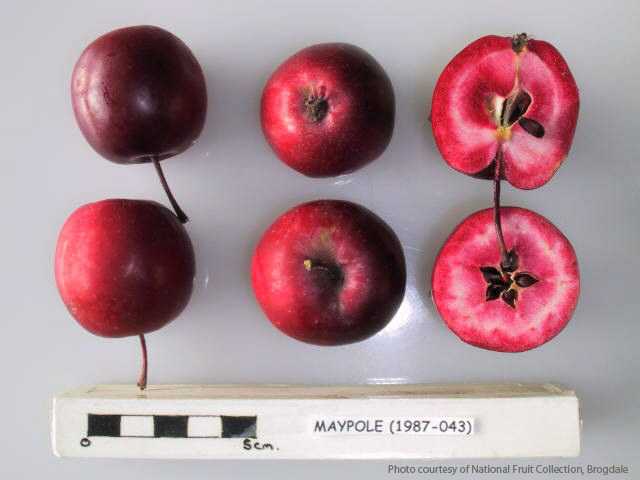
type: Culinary, Cider, Jelly, Ornamental, Pollinization, Sauce
synonyms: Pole apple. In Europe it is referred to as Maypole Ballerina, Ballerina Crab and Ballerina (this is actually the collective marketing banner used in Europe for a series of columnar apples bred at the East Malling Research Station in in Kent (U.K.). In North America the Ballerina name was not available and so the marketing banner for the apple is Colonnade. As such it is known by the synonyms Maypole Colonnade and Colonnade Crab.
summary: Red Blossoms, fruit the size of golf balls, purple with pink flesh.
identification: Medium size crabapples, round to round-conic in shape. The smooth skin is entirely washed crimson over which is an abundance of small, tan-coloured lenticels. The stem is very long and slender, set in a shallow and wide cavity. The calyx is medium size and closed, set in a wide and shallow basin. Surface develops a greasy feel as the fruit begins to ripen.
characteristics: The flesh is stained red, usually a medium red around the core and pink to the skin . Firm. Tart with Mac's strawberry flavours. Tends to brown quickly when exposed to air.
uses: Makes an excellent apple jelly with a pronounced reddish-brown colour. Also excellent apple butter with a distinct red colouration. Occasionally blended into cider for colour and sugar. Ornamental also used for culinary. Makes excellent crab apple gelly.
origins: Initially labelled SA 244-20, this is a cross of Wijcik Spur McIntosh and Baskatong developed in 1976 by Plant Breeding International at the East Malling Research Station in Kent (U.K.). Released in 1986, it was one of the initial varieties of columnar apple trees propagated from a limb mutations found growing in 1962 on a McIntosh tree in the Wijcik Orchards near Kelowna, British Columbia (Canada). The Maypole was one of four varieties developed at East Malling and exhibited in Chelsea in 1989 under the trade name of Ballerina; in North America, they were registered under the name Colonnade since the Ballerina name was not available.
One of six columnar cultivars developed at East Malling Research Station in Kent (U.K.). These include ‘Maypole’, ‘Telamon’, ‘Tuscan’ and ‘Trajan’ (Tobutt, 1985) and ‘Charlotte’ and ‘Obelisk’ released in 1991.
cultivation: Moderately vigorous. Bears fruit on spurs. Compact, columnar upright tree with few, if any side branching. Will tolerate dense plantings. Ideal for small areas and even growing in pots. Requires shelter when grown in areas of high wind to prevent damage to buds since side branches develop primarily when a fruit bud is damaged by disease, cold or physical damage. Dense growth of deep pink flowers. Excellent source of pollen for other apple trees.
cold storage: Does not keep well.
vulnerabilities: Prone to scab. Susceptible to cedar apple rust, fire blight and powdery mildew.
harvest: Ripens during the second period over a considerable length of time starting in the middle of the fourth period
pollination group: B
pollination peak: 7
ploidism: Partially self fertile. Typical of crabapples, it flowers over several weeks.
cold storage weeks: 2
harvest period: 4
flowers: Deep lilac colour, large blossoms.
hardiness: 4
Donate a cider?
©2016-2021 Pomiferous.com. All rights reserved