
Pomiferous
Welcome to the world's most extensive apples (pommes) database.
Information on over 7,000 apples is available here, all carefully researched and provided in a way that is easy to navigate.
Gros Api
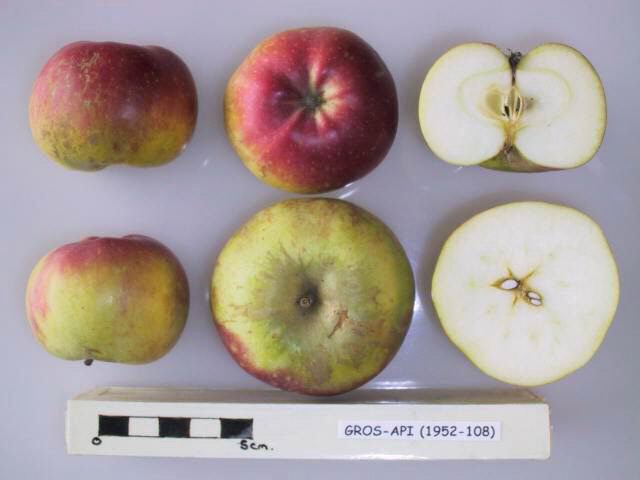
type: Dessert, Eating
synonyms: Api Double, Api Grande, Api Grosse, Api rose, Double Rose, Drap d’Or, Gros Api d’Hiver, Gros Api rouge, Large Lady Apple, Pomme Dieu, Pomme Rose, Rose, Rose de l’Agenais, Rose de l’Angenais, Rose de Provence, Rose Double Api, Rubin, Rubis, Vadiot, Vermillon, Vermillon Rubis
identification: Medium size and round, flattened at the ends and often lopsided, vague ribbing. The skin is thin, very light yellow with light-coloured lenticels. A claret blush usually covers the calyx half of the fruit while the pale yellow base colour shows at the stem half. The calyx is small, closed and set in a ridged basin. The stem is medium to long and slender, set in a shallow cavity which is surrounded by a patch of russet that sometimes radiates over the shoulder.
characteristics: The flesh is white, moderately fine-grained, crunchy and juicy. Sweet-tart.
uses: Fresh eating and baking.
origins: Possibly originated in the Forêt d'Apis in Brittany (France) in the late 1500s. It was first described by Lectier d'Orleans in 1628 in his "Catalogue des arbres cultivés dans son verger et plant" under the name Pomme Dieu. As is the case for all Apis apples, the adjective denotes only that they were found in or around the Forest of Apis and does not in itself infer a common ancestry.
cultivation: Very slow growing and dwarfed tree. Spur bearer. Not suitable for windy areas. Produces abundant annual crops.
cold storage: Keeps for up to four months.
harvest: Ready for harvest in the middle of the fifth period.
notes: In his "Dictionnaire de Pomologie" of 1873, French pomologist André Leroy described an apple called Princesse Auguste which may well be the same as the Gros Api. It could also be related to the Api Rouge which it resembles in shape and size, though not in colour.
pollination group: C
pollination peak: 11
ploidism: Diploid. Self sterile.
cold storage weeks: 16
harvest period: 5
hardiness: 4
Donate a cider?
©2016-2021 Pomiferous.com. All rights reserved