
Pomiferous
Welcome to the world's most extensive apples (pommes) database.
Information on over 7,000 apples is available here, all carefully researched and provided in a way that is easy to navigate.
Gallia Beauty
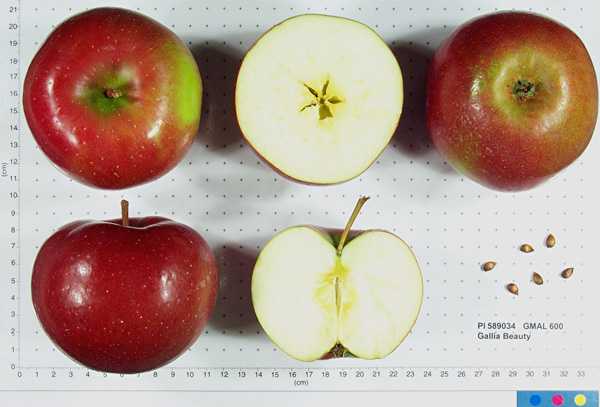
type: Culinary, Dessert, Juice, Pie, Sauce
summary: Either a seedling or mutation of Rome Beauty .
identification: Medium size fruit, round to round-flattened with faintly angular faces. The base colour is greenish yellow to yellow, over which is a red wash. A fine, tawny russet extends out of the stem cavity, occasionally over the shoulders of the apple. The stem is slender and long extending well above the shoulder, set in a medium deep and funnel-shaped cavity. The skin can be slightly waxy when ripe. The calyx is small and closed, set in a somewhat shallow and narrow basin.
characteristics: The flesh is cream-coloured, medium-grained, firm. Somewhat dry, Aromatic when grown in warm, sunny settings. Tends to brown slightly on exposure to air.
uses: The Gallia Beauty has multiple uses, but it works best as a baking and saucing apple.
origins: The story of the Gallia Beauty dates back to the mid-1800s, but it is unclear whether this variety is a mutation or a seedling of Rome Beauty . In "Fruit Varieties in Ohio" published in 1926 by the Ohio Agricultural Experiment Station in Wooster, Ohio (U.S.A.), authors J. H. Gourley and C. W. Ellenwood present the following statement provided by E.J. Riggs of Gallipolis, Ohio. "In 1857 William Coon of Clay Township, Gallia County, whose farm adjoins mine, went to Proctorville, Ohio, and purchased some young Rome Beauty apple trees from the Turley Nursery. These trees were set out on Mr. Coon's farm and given very poor care. About 1862 hogs and cattle destroyed many of the trees, one of them was practically uprooted and, a few feet from the trunk of the tree, there sprung up from the root a vigorous young sprout, which Mr. Coon permitted to remain and take the place of the badly damaged tree. It came into bearing quickly and as the apple was much more attractive in appearance and slightly better quality than the Rome Beauty he propagated a few trees from it. From this start the Gallia spread rather slowly for a number of years. It is now being propagated by at least three nurserymen and is gaining in favor."
Authors J. H. Gourley and C. W. Ellenwood went on to state that "The variety was first known locally as Coon Seedling until ten years ago when Mr. Riggs brought it to the attention of the Ohio Horticultural Society. At that time he suggested the name Gallia Beauty in recognition of the county of its origin."
However, as informative as that report is, it fails to establish whether the Gallia Beauty is a mutation or a seedling. In a 1956 research circular (Some New Apple Varieties) published by the Ohio Agricultural Station, authors C.W. Ellenwood and Thomas Fowler state that "In the group of red strains of Rome Beauty are
several bud sports and at least one seedling (Gallia Beauty)." Several other sources peg the Gallia Beauty as a mutation of Rome Beauty, including the United States National Germplasm System which lists it as a red-fruited mutation of Rome Beauty.
cultivation: Vigorous on its own roots. Bears fruit on tips and produces heavy crops when planted in proximity to a source of compatible pollen; though self fertile, it produces substantially reduced crops on its own pollen. As the tree matures, the branches tend to droop from the weight of apples fruiting from the tips.
progeny: Ruby (Gallia x Starking), Jersey Red (Gallia x White Winter Pearmain)
vulnerabilities: Susceptible to fire blight
harvest: Early in the fifth period. The fruit hold well on the tree past maturity. Ripens over a period of three weeks, requiring multiple pickings for uniformity.
pollination group: D
pollination peak: 14
ploidism: Diploid. Partially self fertile but produces better crops when grown in proximity to a suitable source of pollen.
harvest period: 5
hardiness: 4
Donate a cider?
©2016-2021 Pomiferous.com. All rights reserved