
Pomiferous
Welcome to the world's most extensive apples (pommes) database.
Information on over 7,000 apples is available here, all carefully researched and provided in a way that is easy to navigate.
Dolgoi Squoznoi
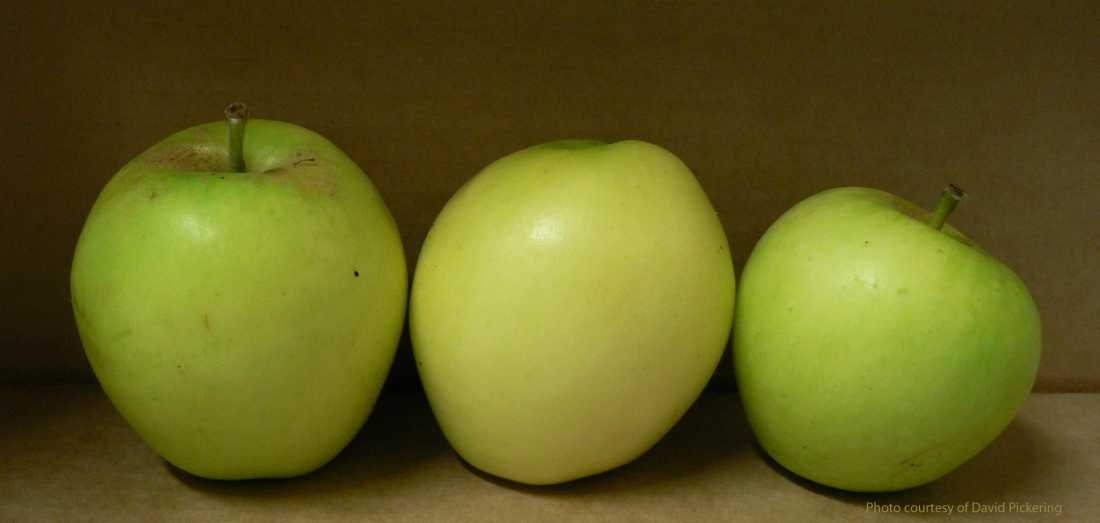
type: Culinary, Dessert, Sauce
synonyms: Dymond's Sugar Loaf, Hutching’s Seedling, Sugar Loaf, Sugar Loaf Greening, Sugar Loaf Pippin
identification: Medium size or larger, round with flattened ends, tall-conic. The skin colour is light green maturing to almost white, over which are russet lenticels. The stem is long and set in a deep and russetted cavity, with the russetting often radiating onto the face.
characteristics: Flesh is white, fine-grained, not overly juicy. Sweet-tart with mild flavours.
uses: A cooking and fresh-eating apple.
origins: Believed to have originated in St. Petersburg (Russia) before the 1800s, most likely a seedling of White Transparent which it closely resembles in many respects. It is, however, better known as Sugar Loaf Pippin and Hutching's Seedling since the early 1800s when it was listed and promoted under these names by several British nurseries. Described by George Lindley in the 1831 edition of his "A Guide to the Orchard and Fruit Garden" as Sugar-Loaf Pippin with the comment "This appears to be of Russian origin, having been sent from the Tauride Gardens, at St. Petersburgh, to the Horticultural Society, London, under the name of Dolgoi Squoznoi, two Russian words, dolgoi, signifying long, and squoznoi transparent." British pomologist Robert Hogg states in his 1851 edition of "British Pomology" that "This variety was introduced from St. Petersburg, by the London Horticultural Society." Somehow, the apple also made its way across the Atlantic Ocean to North America and was reported to have been arrived in Pennsylvania (U.S.A.) around 1824 and was listed as Sugarloaf Pippin, originating in England, by Dr. John Warder in his 1867 edition of "American Pomology."
cold storage: Does not keep well, becoming mealy in a matter of days.
harvest: Ready for harvest in the third period.
pollination group: C
pollination peak: 10
ploidism: Diploid. Self sterile.
harvest period: 3
Donate a cider?
©2016-2021 Pomiferous.com. All rights reserved