
Pomiferous
Welcome to the world's most extensive apples (pommes) database.
Information on over 7,000 apples is available here, all carefully researched and provided in a way that is easy to navigate.
Claygate Pearmain
type: Dessert
synonyms: Archerfield Pearmain, Bradley's Pearmain, Brown's Pippin, Claygate, Claygate Pippin, Doncaster Pearmain, Formosa Pippin, Fowler's Pippin, Mason's Ribston Pearmain, Ribston Pearmain, Summer Pearmain, Winter Pearmain.
summary: An esteemed heritage dessert apple which was widely grown in the gardens of Victorian and Edwardian England.
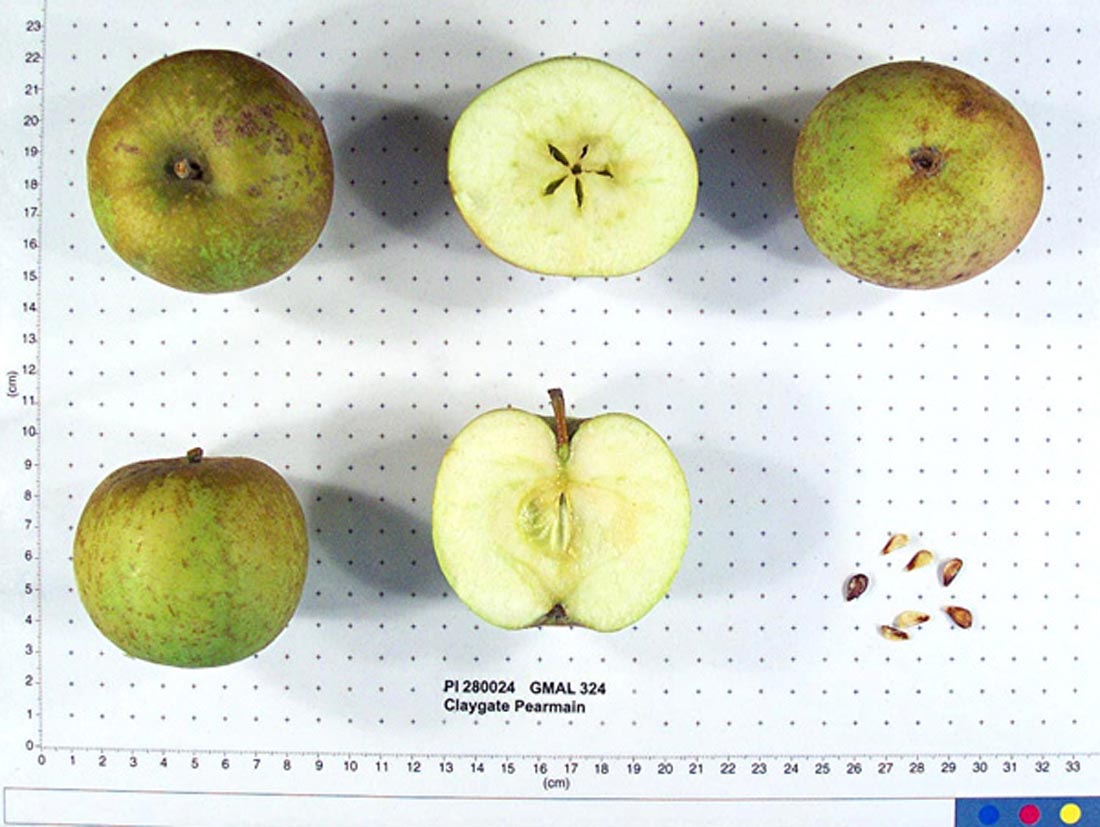
identification: Medium to large, round tending to conic. The base colour is greenish-yellow over which is a crimson to orange-gray flush on the sun-exposed face with scattered red striping. Russetted with a silvery scale, sometimes a pink tinge. The calyx is large and open, set in a shallow, faintly crowned basin. The stem is medium long and set in a deep cavity.
characteristics: Flesh has a yellow, sometimes greenish tinge. Crisp, somewhat crumbly and sweet. Full, rich, nutty flavour, sometimes pineapple.
uses: Poultice made from rotten Claygates were used in old country remedies for sore eyes.
origins: A wild seedling discovered growing in a hedge near his home in Claygate Village, Surrey (U.K.) by John Braddick a horticulturist who also discovered the Braddick’s Nonpareil under similar circumstances. First described in the Journal of the Royal Horticultural Society in 1862 and subsequently received the Royal Horticultural Society's Award of Merit in 1901 and the First Class Certificate in 1921. Nevertheless, it went out of production at the start of the 1900s and was considered lost until a tree was found at the Grove Research Station in Tasmania (Australia) in the early 2000s.
cultivation: Moderately vigorous, upright spreading tree. Bears fruit on spurs. Heavy bearer. Well suited to being trained as an espalier.
cold storage: Keeps up to two months in storage with best flavours and aromas developing after about four weeks. The flesh becomes increasingly cream-coloured in storage.
vulnerabilities: Resistant to scab.
harvest: Ready for harvest starting in the second half of the fifth period.
notes: The outspoken pomologist/nurseryman and author, Edward Bunyard (1878-1939), listed the Claygate Pearmain as one of the top 12 finest apples in the world
pollination group: D
pollination peak: 12
ploidism: Triploid. Self sterile and produces no viable pollen for itself or other apple trees.
cold storage weeks: 8
harvest period: 5
hardiness: 3
Donate a cider?
©2016-2021 Pomiferous.com. All rights reserved