
Pomiferous
Welcome to the world's most extensive apples (pommes) database.
Information on over 7,000 apples is available here, all carefully researched and provided in a way that is easy to navigate.
Christmas Pearmain
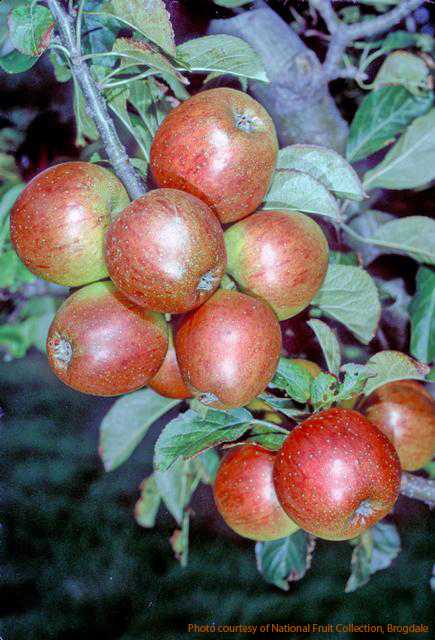
type: Dessert
identification: Small to medium size. Long conic. The base colour is green maturing to yellow, flushed orange to brownish-red on the sun-exposed faces comprising half to three-quarters of the surface over which are darker red stripes. Some russetting. Abundant russet lenticels. The calyx is large and open, set in a shallow basin. The stem is short and set in a shallow cavity.
characteristics: Flesh is yellowish, quite firm and fine-grained. Juicy and sweet with some sharpness, sometimes somewhat astringent. Aromatic.
uses: dessert
origins: Raised from a chance seedling by H. Manser of Kent (U.K.) during the late 1800s. First described by P. Crowley in the 1894 "Journal of the Royal Horticultural Society." Listed by the George Bunyard & Company Nursery of Maidstone, Kent (U.K.) in 1895.
cultivation: Moderately vigorous, upright, compact. Spur bearer. Tends to bear every second year. Easy to grow and good cropper.
cold storage: Keeps three months, flavours and sweetness peak toward the end of this period.
vulnerabilities: Scab resistant.
harvest: Early in the fifth period
notes: Originally Pearemain or Peare main or Paremaine, Pearmain is the term used to signify a pear-shaped apple. It comes from an Anglicization of Pyrus Magnus meaning shape of a large pear. Another less likely explanation is that the term pearmain is an Anglicization of the French term “permanus” meaning that it originates from the town of Parma in northern Italy.
pollination group: B
pollination peak: 5
ploidism: Self fertile but crop improves in proximity to a source of viable pollen.
cold storage weeks: 12
harvest period: 5
Donate a cider?
©2016-2021 Pomiferous.com. All rights reserved