
Pomiferous
Welcome to the world's most extensive apples (pommes) database.
Information on over 7,000 apples is available here, all carefully researched and provided in a way that is easy to navigate.
Bismarck
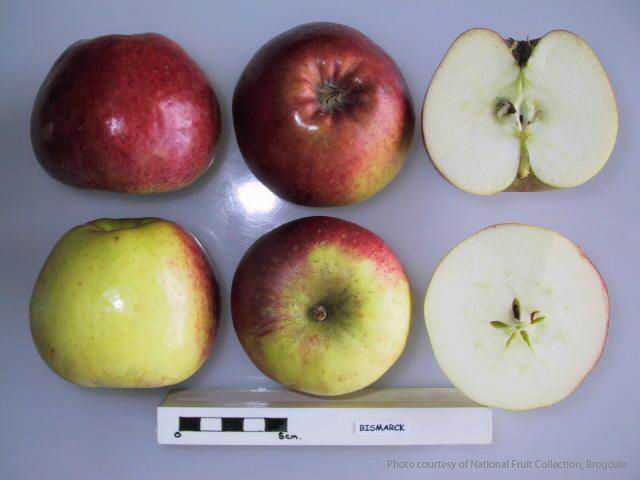
type: Cooking
synonyms: Bismark, Prince Bismarck, Prince Bismark
identification: A medium to large apple. Round conic. Green skin washed red and marked with darker stripes on the sun exposed surface. Small, dark lenticels, mostly visible on the shaded face.The eye is medium to large and partly open, set in a deep and narrow, often puckered basin surrounded by a prominent five knobbed crown. The stem is short and stout, set in a deep and narrow, russeted cavity.
characteristics: The flesh is white, fine-grained and firm, but mealy when over-ripe. Juicy and acidic and somewhat astringent.
uses: Cooking apple produces a brisk and fragrant, golden yellow puree.
origins: Thought to have been developed either at the German settlement of the same name in Tasmania (Australia) around 1870 or by F. Fricke, a German settler in Carbrooke, Victoria (Australia), in 1861 who named it after the German chancellor Otto von Bismarck . Popular in Australia and Europe until the 1930s.
cultivation: Small, spreading tree. Spur bearer. Precocious. Good cropper but needs thinning in order to get larger apples. Blossoms are easily damaged by late frosts.
cold storage: Keeps up to four months but flavour is best after siux weeks in storage..
harvest: In the first half of the fourth period. The fruit hangs well on the tree at maturity. Problems: Susceptible to mildew
notes: This apple a high Vitamin C content. 8mg/100g
pollination group: C
pollination peak: 8
ploidism: Diploid. Partially self-fertile.
cold storage weeks: 16
harvest period: 4
Donate a cider?
©2016-2021 Pomiferous.com. All rights reserved