
Pomiferous
Welcome to the world's most extensive apples (pommes) database.
Information on over 7,000 apples is available here, all carefully researched and provided in a way that is easy to navigate.
Biesterfelder Renette
type: Dessert
synonyms: Biesterfelder, Biesterfelder Goldrenette, Biesterfelder Reinette
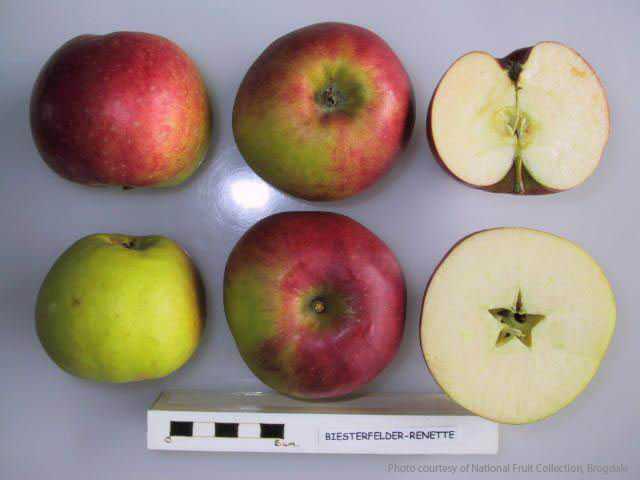
identification: Large. Round tending to conic, sometimes angular and irregular. The base colour is yellowish green over which is a dense pattern of cherry-red stripes on the sun-exposed surfaces. Abundantly marked with small, greenish, raised lenticels. The calyx is closed and set in a deep, irregular and slightly puckered basin. The stem is short to moderate in length and set in a deep cavity which is russetted with greyish-green rays extending onto the shoulder. The skin tends to develop a greasy feel when ripe and in storage.
characteristics: The flesh is yellowish and tender. Very juicy and flavourful with aromas of sweet wine and lightly spicy. Remarkably similar to the Gravenstein apple.
uses: Dessert apple.
origins: Found as a chance seedling on the grounds of Biesterfeld Castle near Lüdge in the North Rhine-Westphalia region of Germany. First described in 1904 by German theologian Wilhelm Wilms who propagated and promoted the variety. There is no record of its parentage.
cultivation: Vigorous and spreading. Bears abundant, annual crops. Tolerates damp clay soils and grows best in warm or temperate conditions, with plenty of sun.
cold storage: Keeps up to two months in cold storage, quickly turning mealy toward the end of this period.
vulnerabilities: The blossoms are sensitive to frost. Highly resistant to scab.
harvest: Ready for harvest in the latter half of the fourth period.
notes: This apple bruises easily and does not transport well.
pollination group: C
pollination peak: 9
ploidism: Diploid. Self sterile.
cold storage weeks: 8
harvest period: 4
Donate a cider?
©2016-2021 Pomiferous.com. All rights reserved